Steve’s Travel Journal
Epic Trails Cattle Drive
Whitewater, Montana
May 2010
The following is the journal of our trip to Montana to have a “real working ranch experience.” The brochure claimed: “You will learn to ride herd, throw a lasso and round-up strays. You will experience a whole new perspective as you view the panorama and you will actually help round-up and move more than 250 head of cattle across prairie, between coulees and through farmland.”

The brochure was mostly true! I didn’t learn to lasso (my own fault) and it failed to mention the mud. More on that later.
For those who like accuracy, I apologize for any errors. But reading this journal will give you an idea of what we experienced during our “ranch experience.”
Saturday, May 22; Malta, Montana, The Starting Point
We rolled into Malta at dinner time, towing our little Arctic Chalet travel trailer. We had picked it up in Kalispell that morning. At the time we didn’t have any idea how much we would appreciate that little trailer!

The other guests, arriving from all points of the compass, were gradually assembling at the Edgewater Inn, a classic small town motel/RV park next to Highway 2 at the edge of town. Rather than stay in the Chalet we took a room so we could enjoy our last shower for a week and then joined the others for dinner at the Great Northern Hotel in town. It was the first time the group, minus the still traveling Belgian women, gathered in one place.
It was a diverse group and, we would discover, most had been on the trip before.
• Penny Nicholls and Connie Cox were the trip leaders.
• Steve and Kathy Dennis and Jerry and Linda Cufley were trip rookies.
• Sally Walker had been on other trips but not the Whitewater experience.
• Dave Horsey, veteran
• Don Anderson and Ann Graham, veterans
• Paul Masson and Connie Lodell, veterans
• Kathy Sidaris and daughter Cindy Sidaris, veterans from California
• Ann Nogatch and “Just” Bill Ayers, veterans
• “Real” Bill Coffin, Ann’s father and a rookie
• “Florida” Dave Morres, veteran
• Cloe and Sara Buytaert would arrive from Belgium Saturday morning. Both were new to the trip but experienced riders.
The trip veterans were full of “remember when” stories of past trips and the evening flew by. A few hardy travelers wandered to the VFW hall to see what was happening while we headed back to the “Inn” to “bed down” for the night. (I’m already learning the language!)
Sunday, May23; On to Whitewater
The day dawned sunny and bright. We ate a hardy breakfast at the Westside Café, across the highway, and then returned to the motel to view a video of a past trip. It was interesting and gave us a small look at what to expect when we arrived at camp. Then the guests disappeared to enjoy the luxury of flush toilets and running water one more time.
Cloe and Sarah, straight from Belgium, rolled in at 10:55 just in time for our scheduled 11:00 departure. It was quite a convoy. Eleven vehicles, five horse trailers and two camp trailers formed a loose line and headed north. The first 23 miles were paved and smooth going. We then turned onto a dirt county road which continued about 25 miles passing through the small town of Whitewater on the way. At that point we turned onto Turkey Track Road and the trip became exciting.

Sections of this road were in fairly good shape. But, as a result of the unseasonably wet weather, parts were little more than water filled ruts of unknown depth. We followed and trusted, after a fashion, Penny with her truck and trailer. We were a little concerned about Cleo and Sara in their little Nissan rent-a-car but they soldiered on, dodging the deepest ruts. At times we had to abandon the road and head out across the prairie.
After an interesting drive we passed through the final gate and eased into a gently sloping prairie next to a series of permanent corrals. This prairie would be our home for the next week.
Two impressions greeted us. First was the wide open remoteness of the place. Rolling green hills, crossed by an occasional fence, surrounded our camp area. We later learned that the ZN Ranch comprised 29,000 acres of range land; about 20,000 of which was owned by the Bureau of Land Management or BLM. That is a lot of real estate!
The second impression was of the wind; it seemed to blow all the time. I thought we would have a prevailing wind; it was from the west when we arrived. But that wasn’t the case. Over the week the wind would change direction frequently and rarely let up for any length of time. Connie used his long stock trailer as a mobile wind break, moving it from side to side around the eating area or campfire depending on the direction of the wind.
We were told to set up camp “wherever we wanted.” Kathy wanted a room with a view so we set up our Chalet trailer a little below the cook trailer with a view to the north. Dave Horsey and Cleo and Sara set up their tents in the same area. Paul and Colleen arranged their horse trailer/camp trailer (it had sleeping quarters in the front) near the cook trailer to provide some additional wind protection. The others were scattered on the hill above the cooking area.
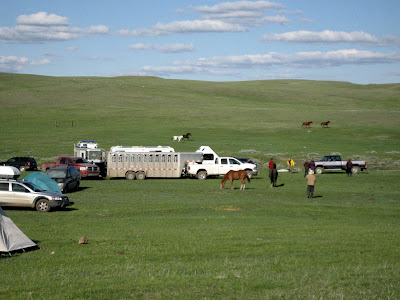
Shortly after arrival the horses were simply turned loose. While the area we were in was fenced, the horses had free access to many acres. They loved the freedom and were soon running around the camp and onto the surrounding hills. It was a joy to see them running relatively free. Most of them don’t enjoy such wide open spaces at their home corrals.
A horse or two were kept in camp for Paul to use in the morning when he rode out to “round up” the horses and bring them in.
By 7:00 p.m. dinner was done, the wind had subsided, the campfire was burning and the hardy of the guests were gathered telling tales of past roundups while enjoying adult beverages of various sorts.
The sunset was marvelous.
Monday, May 24th; Gathering the Bulls
Paul left camp early on a task he seemed to relish; rounding up the horses. It is amazing how the sound of galloping horses carries across the open country. Guided by Paul and his most capable steed, the camps horses were soon secure in the corral awaiting their day’s assignment.
The first day on the horses required some sorting out. About half the riders had their own horses and tack (I learned that was the saddle, bridle and stuff!). The rest of us were assigned horses and provided with blankets, saddles and bridles that we would use the rest of the week. Connie has an interesting collection of saddles, many of them won years ago when he was on the rodeo circuit.

Kathy was assigned Jake, a pretty little horse with an independent streak. She would spend the day arguing with Jake. But she wasn’t intimidated and had a successful day without serious incident.
I was assigned Spot, one of the biggest horses in the paddock. Since we were both broad across the stern I guess Connie thought we would be a good match. We got along just fine the entire week.
Soon eighteen guest/wranglers were mounted and ready. Don launched the 2010 cattle drive with the classic words, “…let’s ride.” John Wayne would have been impressed.
And ride we did, trotting off to our first assignment; moving about 14 bulls to a new pasture. Since the riders outnumbered the bulls we had a clear advantage. In any case, they seemed happy just about anywhere there was food available.
The gently rolling green hills that surrounded the camp gave way to steeper gullies as we moved the bulls to their new home. That meant going up and down some steep slopes and, it was on one of those slopes that I ran into my first adventure.
Spot and I were descending the side of a gully when I found myself slipping inexorably to starboard until I was lying unceremoniously on my back in a bush beside old Spot. To his credit he took the whole incident quite well, waiting for me to recover my dignity and feet. With the saddle nearly under him the experienced riders feared he might spook but he maintained his composure and followed me to the bottom of the slope where we could work on the cinch and saddle. Ann and Cindy, veteran equestrians, were nearby and gave much appreciated assistance getting me, as they say, back in the saddle again.
Kathy, Connie, Penny and most of the wranglers were far ahead and had no idea I’d been riding under rather than on my horse. We had to do some riding to catch up with them and the bulls we were supposed to be herding.
The morning ride proved to be a good check out time. Riding up and down steeper slopes was a new experience for me and required some style adjustments on my part. Dave Horsey made rein holding suggestions which were invaluable when I needed to slow Spot down in, what I found to be, panic situations. All the veteran riders were free with help and suggestions and, regardless what they thought of my riding prowess, were patient and kind.
The bulls were deposited in a pasture near the home of Clinton Cox, Connie’s son. We then stopped at his home for lunch out by the barn. It was nice to be on the ground for a few minutes even if the ground was a bit on the muddy side. This was tame mud. In a few days we would learn about real Montana mud.
After lunch we gathered up 14 heifers with calves and moved them closer to our camp so they would be available for branding later in the week.
We arrived back in camp around 3:30 after five and one half hours in the saddle. Nothing was damaged except my pride and the day could be counted as a success. We put our saddle and gear in Connie’s big stock trailer, let our horses loose and headed to our respective campsites.
The weather was beginning to kick up with a strong east wind, slate gray skies and an ominous forecast.
By dinner time the wind had shifted so the stock trailer was moved to a new spot in the “U” that surrounded the tables. Everyone placed their chairs in the lee of the trailer for wind protection. Then the rain began and we improvised.
A large blue tarp appeared and, with the aid of many eager hands, was draped over the top and windward side of the stock trailer, secured with straps and shock cords. Then the saddles and gear, which had been carefully stored in the trailer for easy access, was unceremoniously tossed into the front of the trailer to make room for the camp chairs and many of the 18 guests. Wind rocked the trailer and the rain attacked the blue tarp but the interior was quite comfortable considering the alternatives.
After dinner Don broke out his IPOD music system with speakers and soon the trailer was throbbing with sounds not often heard on the lone prairie. Don also demonstrated his magic camp coat. He could reach into any of the many pockets and produce a beer, foreign or domestic. He was very popular.
Kathy and I finally retreated to our little Chalet trailer, thankful that we had it and that it, so far, had proven to be water tight. At times, during the night, I thought someone had turned a fire hose on the trailer; the wind driven rain just pounded the walls. I considered tying it down but concluded our center of gravity was low enough we would survive the worst the storm gods could provide.
Tuesday, May 25th: Hunker Down in Camp
With the dawn, soggy guests began to wander toward the cook trailer in search of hot coffee and a dry place. We had faired just fine but the tent dwellers suffered greatly.
Jerry and Linda moved into their Volvo wagon. Their tent was still standing but motion and noise had been so unpleasant that they opted for a more stable platform.
Dave Horsey moved to his Jeep. Cindy moved into the cook trailer with her mother.
Ann and “Just” Bill were the only ones to remain in their spacious and, as it turned out, rugged tent home for the entire time.
Cleo and Sara, with a small tent and small car, had endured the lousiest night. When morning came they moved to their little car, wrapped in warm clothes and watched a movie on their laptop. (Later in the day they accepted Don and Ann’s kind offer and moved into their horse trailer for the duration of the trip. Swept clean, with a carpet rolled out on the floor, it turned out to be quite nice and a four star improvement over their compact travel tent.)
Those that started out in trailers or vehicles had survived with minimal inconvenience.
On a positive note, much of the mud we picked up on the cars driving in was washed off by the storm!
The plan for the day had been to brand the calves we rounded up on Monday. But, we learned, you can’t brand a wet calf and the calves were very, very wet
With no assigned work we were free to stay in camp or go riding if we wished. A few braved the elements but most just hunkered down for the day. The cook trailer was very popular with a rotating crew of 5 or 6 most of the time. Our Chalet was also crowded with lots of chatter and a continuous game of dominos.
It rained and blew all day. It wasn’t as nasty as the night before; more of a “when is it going to quit raining and blowing” kind of storm. As soon as someone would remark, “the wind seems to be letting up” the Chalet would get slammed with another blast. It was the same with the rain.
When there were breaks in the weather we would often see “Real” Bill exploring the nearby hills in his bright yellow parka. He often came back with small bits of wood for the evening campfire.
Finally, around 4:00, the clouds parted, the wind died and the sun offered us a beautiful evening, just right for a camp fire.
Wednesday, May 26th; The Day We Earned Our Spurs or A Day in the Mud.
The Tuesday evening sun held; Wednesday would be sunny and nice.
The plan for the day was, to me, a little vague. But it evolved like this: We would do the Tuesday branding in the morning and then move to the Wednesday roundup. What I didn’t realize was that the Wednesday roundup was an all day event covering a fair amount of territory(about 20 miles!) and most of that territory would be muddy, a product of the Tuesday storm. Combining the two events meant a long day in the saddle.
Prior to the branding we gathered the pairs we had rounded up on Monday along with another larger group, about 50 pairs in total, and brought them down to the camp corral. There Connie’s son, Clinton, his daughters and several neighbors were waiting to take the lead role in the branding enterprise. The process went something like this:
• Bring in the heifers and new calves.
• Separate or cut out the calves from the heifers. (This results in a great deal of bawling as they wish to be reunited as soon as possible.)
• Set up a fire, wood or gas, and heat the branding irons.
• Set up vaccination equipment.
• Ride into the calve pen, lasso their hind legs and drag them out to the waiting branding team.
• One person kneels on the neck while another holds a hind leg to keep the calf in position. Then:
Clinton cuts off part of an ear to mark the females.
Two people vaccinate.
Brand with a hot iron or two
Release and send out to “mother up.”

I don’t want to over simplify the process or the planning for it but those are the essential elements. It takes a village to brand and it is clear the neighbors in “these parts” support each other and help out at branding time. (We would see that neighborliness in action again on Friday, during the “big” branding.)
We took the newly branded pairs back to their pasture after giving them a few minutes to “mother up” as Connie described it. To mother up we simply held the small herd at a fence line and let them mingle until they quit bawling. The lack of noise suggested the mothers and calves had found one another and that all was right with the herd.

Wednesday Afternoon, Part Duex, The Roundup
Following lunch the first group of about ten wranglers headed out for the “roundup.” I was completely turned around most of the day. I couldn’t have found my way back to camp with a GPS, which I didn’t have. I thought we were heading north. A later examination of Google Earth suggests we were actually heading southeast. The directions and place names I use here were obtained after the fact. At the time I didn’t have any idea where we were!
The first assignment fit my perception of a “roundup.” We passed though a gate into a new part of the ranch and then split up to gather all the cattle we could find. Sally and I headed left and rousted several outliers from the gullies. It took less than 30 minutes to run our five head up a ridge to join the rest of the wranglers. Our small group had collected about 60 pair. I was quite pleased with our work; an average of six pair per wrangler. Then Clinton sent us back to earth. By himself, with his three dogs, he took our cattle and sent us off further south down the banks of Sand Creek.
Getting there was not too bad; lots of ups and downs as we descended the coulees along the edge of the Sand Creek depression. I’m not sure how Sand Creek got its name. Clearly the first settlers arrived later in the year. If I was naming it based on our experience it would Mud Creek.
Despite the rains the creek wasn’t much of a water way; more of a series of braded little rivulets wandering around the valley floor. In most cases the horses could step over them with little effort.
The problem was the mud. The soil had retained the water like a muddy sponge. Even in the “firm” areas there was a two or three inch scum of mud on the firmer soil beneath. The edges of some rivulets were even boggier which made Spot a bit leery of crossing them. In other areas, often near the edge of the valley floor, mounds of mud seemed to be pushed from below. While looking firm they could take a horse in up to its knee.
Coming down the creek we had assembled about 30 pairs in a loose herd. Off to the west, on a ridgeline, we spotted some outliers so Penny led a small group that direction to bring them in. After a long wait we were directed to “move’em out” and head for Frenchman’s Creek which meant climbing a muddy ridge with the cattle. A few of our brave wranglers took the cattle to a fence line and then began the muddy climb. The rest of us looked for a better alternative. Spot was struggling on the steep muddy slopes so I dismounted and led him up and down and up again until we reached the top of the ridge.
We joined up with the “fence line” group and were relieved to see Paul and Connie join us with a small herd they had gathered. Their experience proved invaluable and, best of all, they actually knew where we were and where we were going. Hurray.

What I didn’t realize at that time was how far we had to go. It was about 4:00 pm and we were only half way home. We were now by Frenchman’s Creek heading north. The mud was less pervasive but it was still present. We were ambling across level ground spotted with small green bushes. The cattle tried to sample every one. It was a constant push to keep them moving at a pace that would get us in by dark.
Spot, by this time, was one tired horse. He had plenty to drink but the mud was sucking his energy. He was willing to track the herd but reluctant to chase after heifers that would wander off to either side. Connie and Paul were everywhere encouraging both the cattle and the wranglers.
We were pushing about 50 pairs. As the evening approached the herd devolved into a “fast” group and a “slow” group. Paul, Kathy and Dave Horsey were with the fast group. After Paul turned them from Frenchman’s Creek into Kennedy Coulee, which would lead them to camp, he returned to encourage our slow cattle. The group was slowed by their constant bush snacking and by little “Norman,” a very young calf, which was bringing up the rear. He was a game little guy but, like many of the horses, he was just plain tuckered out. I pictured him coming home draped across someone’s saddle, a la City Slickers.
Finally, after eight hours in the saddle, as dusk descended, we emerged from Kennedy Coulee to the welcome sight of the little camp. Spot and his horse friends were most grateful to be unsaddled and released to run free another night.
A late chicken dinner was most appreciated.
Thursday, May 27th, A Lazy Day and Farewell Florida Dave
The plan for the day was simple.
1. Clinton would fly the ranch in his little plane and spot the cows we missed on Wednesday then,
2. We would go get them.
The plan for the day changed.
1. Low clouds kept Clinton on the ground.
2. It was windy and cold so the prospect of a ride was not that appealing and,
3. I’m not sure anyone would have actually gone back to the muddy valley to find more cows even if he could have flown.
So it was a win-win for everyone except Clinton.
1. Any missed cows got another day of freedom.
2. We didn’t have to go back in the mud and
3. Penny and Connie did not have to deal with a potentially ugly wrangler mutiny.
Instead most spent a relaxing day in camp or took short rides when the weather looked most favorable.
Florida Dave had to leave to make his return three day trip home. His van lacked the clearance of a four wheel drive vehicle and we had some concern about his ability to navigate the first five miles of the road considering the rain we had accumulated the past few days. “Just” Bill volunteered to escort him through the worst section so I hopped in his truck and joined him for a morning ride. Dave had no trouble so we bid him goodbye at the county road and headed back to camp.
Kathy was invited to join Connie, Penny and Clinton’s friend Jimmy for a supply run to Whitewater. What she didn’t realize was the ride would be four in the front seat of Connie’s old truck with “four on the floor.” It was cozy. When they arrived in Whitewater they discovered the last store had closed in 2008 which meant another hour of driving to Malta. For the return trip she squeezed into the jump seat with Connie’s tools and tire chains freeing up space in the front seat.
Late in the afternoon we left Jerry, Linda, Penny and Sally in the Chalet with the dominos and joined Don and others for a late afternoon ride to a ridge for a territorial view into the Frenchman Creek valley. It is big country.
Serious rain began just as dinner was served forcing everyone into protected areas. The Chalet, the cook trailer and Ann and Don’s camper became popular gathering places.

Friday, May 28th; The Big Branding
This was to be the big day, the culmination of the weeks work. It was branding day. Neighbors help neighbors at branding time.
There is a country music video, “You’ll Find Out Who You Friends Are,” where trucks, tractors and vehicles of all types arrive to help a country friend in trouble. I was reminded of that scene at 7:30 when, as if on cue, trucks pulling stock trailers began to arrive at the branding area in a nearby pasture. Already saddled horses came out of the trailers and soon the ranch was crawling with neighbors intent on rounding up Clinton’s cattle for branding.
The cattle didn’t stand a chance. Our group joined the neighbor riders creating quite a scene of horses, riders, heifers and calves spread across the rolling green hills. By 8:30 about 200 pair were tucked securely in the Clinton corral.
At that point the branding ritual, not much changed for generations, began again. It was similar to the Wednesday branding but on a larger scale. Calves were cut away from the heifers who expressed their displeasure from outside the corral. Fires were built, irons heated and then, when all was ready, Connie sauntered into the corral. With a practiced hand, he roped the first calf, dragging it out to the waiting hands of two young neighbors.
At full production five riders were busy roping, delivering squalling calves to ten “holders” who restrained the squirming creatures for shots and branding. When one was release another would arrive with smooth timing. There is no “clean” way to hold a calf on the ground and the holders soon had muddy knees and seats to prove it.
At the end Connie expressed the belief that this had been one of the smoothest brandings he could recall. In spite of the fact there were usually five calves on the ground, horses moving between them, hot branding irons waving about and people carrying vaccine guns no one was injured, inadvertently branded or inoculated. And everyone seemed to have a good time.
By 11:30 it was over.

While we were “branding,” Clinton’s and Connie’s wives, Denise and Linda, prepared a wonderful country picnic spread back at our camp. Everyone was invited and it was an all American eating affair.
• Burgers,
• Beans
• Fried chicken
• Chips
• Three kinds of salad (potato, corn, etc)
• A stunning array of desserts.
Everything was homemade except the chips and beer.
It was interesting to watch the guests. The young people ate together while engaging in animated conversation. Most of them had grown up together so were both neighbors and friends.
The adults drifted into two groups; the neighbors and our group of guests. There was some overlap of adults and an opportunity to talk with the men who had worked so hard all morning.
As I chatted with a neighbor over fried chicken I was struck by how different our lives were. I live ten minutes from a doctor; he’s two hours away. I am concerned about the weather so I know if I can cycle; he is concerned because it impacts the grasslands, the food for his herd. I live within five miles of probably 25 coffee shops; he makes coffee in his kitchen. I need four wheel drive to get to the ski hill; he needs it to move around his property or get to town.
We seemed to have more in common with Cleo and Sara, two women from a foreign country, than these hardy men and women from the Montana hi-line country.
The ranchers I spoke to were rightly most concerned about crops, weather, cattle prices and farm equipment. Their homes are so remote they, of necessity, depend on each other for help and support when needed. They struck me as friendly, real, unpretentious people. (That was also true of the people we met at the VFW Hall in Malta a few days later.)
After lunch the visitors went on their way and the rest of us spent a lazy afternoon. Some hung around while others took “one last ride.”
Late in the day Connie moved the stock trailer into “wind break” position beside the fire. Those in camp gathered by the fire and listened to a few more “Connie” stories. At one point he asked the guests to recount their best and worst moments of the week. “Real” Bill, Ann’s spry old father, was just happy to be anywhere with his daughter. Some expressed the pleasure of seeing the horses run free at the end of each day. Cleo thought the trip was all they hoped for, perhaps more. While the weather had presented challenges for everyone there were few complaints. The “best” recollections clearly outnumbered the “worst.”
The campfire was a reflective and satisfying way to end the week of adventure.
Saturday, May 29th; Time to Go Home
Saturday was to be a travel day, not a day of adventure. But there was adventure waiting for us just down the road.
The camp came down as easily as it had gone up. We finished with our Chalet and hooked it up to the Highlander for a quick departure. Connie hitched the cook trailer to his black pickup and moved his stock trailer to the corral so the horses could be loaded.
We waded, literally, into the corral to gather the seven horses that were going with Connie. Penny and Ann loaded their horses as well. Soon, without fanfare, Connie began rolling toward the gate with Penny, Sally, Ann, the Cufley’s and us in train behind. I wanted to stay with the group since I wasn’t sure I knew the way out and directional signs were nonexistent on the ranch and county roads.
Cleo, Sara and David were helping with Don and Ann’s horses and would join Paul and Connie for the next “train.”
It turned out that our drive into the camp had been a freeway drive compared to the drive out. Problems began at the first gate. Five vehicles cleared the pond at the gate but the sixth, Sally with seven horses in tow, was sucked into the mud until it was go-no-mo. No amount of cajoling could get the truck moving so the horses were unloaded, an SUV hooked to the truck and the rig was pulled clear.
Where necessary we avoided the road, driving in the adjacent prairie instead. But alternative routes were not always available. Our little convoy sluiced and slid up, down and across the rutted, flooded roadway. There were many times when I wasn’t sure we would make it but the Highlander soldiered on with the little mud splattered Chalet clinging behind.
Finally, about a half mile from the maintained county road, Sally’s big rig settled into the mud and refused to move. A look ahead indicated we were in for more of the same so the horses were unloaded and began a walk to the county road. Free of its load the big white truck was able to extricate itself and jumbo stock trailer and, after one last struggle up one last slope, made it to the county road. The rest of us, feeling a profound sense of relief, followed close behind.
Even the county road proved to be so slippery that Connie had us assemble on the high or left side out of fear that we would slide sideways into the ditch if we moved to the lower or right side.
The rest of the drive was uneventful. We ended the trip where it had begun, at the Westside Café in Malta. As we were finishing lunch David, in his Jeep, and Cleo and Sara, in their little Nissan, rolled into the lot and told their tale.
They left camp with Don, Ann, Paul and Connie. Don and Ann were in their pickup with a camper on the back, towing their horse trailer. Paul and Connie were in their pickup towing their 5th wheel stock trailer. At some point Don become mired. Paul intended to drop his trailer and then tow Don out. Don and Paul encouraged the others to press on, which they did. Cloe and Sara used a time tested approach to the mud; drive like hell and hope for the best. It worked. Dave’s Jeep did just fine.
At about 5:00 pm, when Don and Paul arrived at the Edgewater Inn, we learned the rest of the story. Apparently Don became stuck and was unstuck several times. Finally he managed to get so stuck that Paul simply could not budge him. With the camper on the back there was no way to lighten up Don’s rig so they had to call a friend, John Deere.
Paul was acquainted with some of the neighbors from previous trips to the area. He went to a ranch with a tractor but found everyone was away at a branding. He made some calls and finally made the right contact who gave him permission to borrow the tractor. Thus equipped he made it back to the road and extricated Don from his muddy predicament.
Most of the guests had lunched in Malta and then headed west on their homeward journeys. We stayed on in Malta along with Dave Horsey, Paul, Connie, Don and Ann. We gathered at the Stockman Bar and Steakhouse for dinner and then spent an enjoyable evening at the VFW hall where country musicians from around the area were participating in a traditional Memorial Day music fest. It seemed like an appropriate way to end a week on the “ranch.”
Sunday it would he off for home for all.
REFLECTIONS
Friends often ask, “how was it? Why would you want to do it? How was your hotel room?”
We try to answer their questions which cause them to be even more suspicious of our rationality.
Cleo and Sara answered the questions the best; they were looking for the “real thing.” They didn’t want warm cabins, restaurant meals and evening entertainment (singing cowboys and dancing Indians.) Lots of “dude” ranches offered that. They wanted to taste life on a working cattle ranch.
And we did.
For five days we were exposed to a snapshot of life on a working cattle ranch. It was just that, a snapshot. We heard a great deal about ranch life but we experienced just a snippet of it. It took ten of us to round up 50 pairs. Clinton does it by himself with three dogs.
We didn’t have a blizzard. We don’t know what it’s like to go to a K-12 school with 40 kids, all grades. We didn’t have to drive two and a half hours to go shopping in Havre.
But as little as we saw I gained an appreciation for the spirit and resilience of people who have chosen to live in such beautiful but remote country. I will never look at a steak the same again.

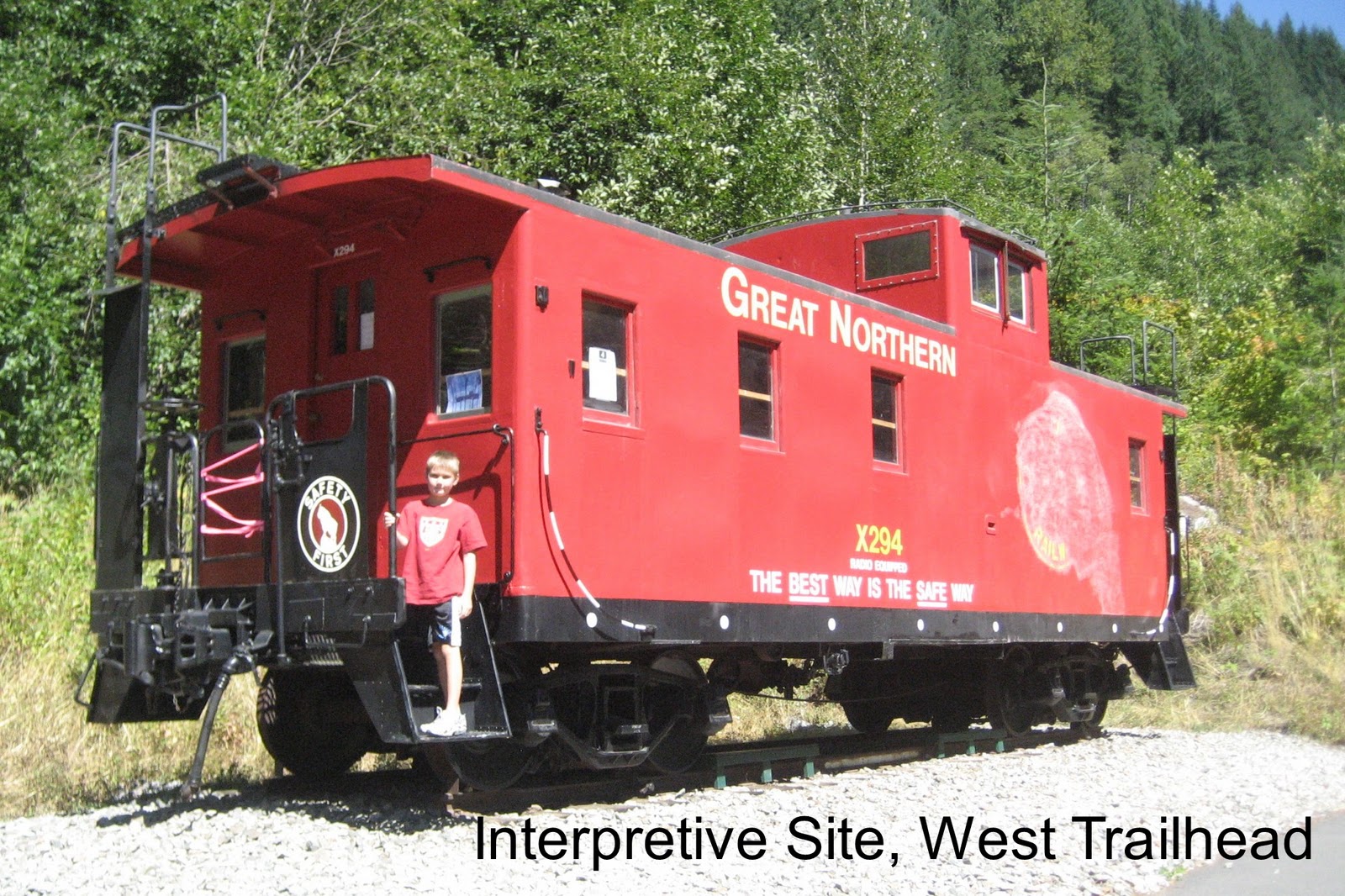
 A combination of snow and temperature conditions combined to bring down a colossal slide the night of March 1st. The idle train was swept from the tracks and crushed on the slope below. With tracks still blocked rescue crews had to climb a steep slope at Windy Point and hike three miles on the still dangerous and snow covered track to reach to accident site. News of the Wellington disaster swept the country.
 Cameron selected the east, or Wellington end, as our starting point. It was reached by turning north, off of highway 2, at highway milepost 64.3 just short of the Stevens Pass summit. Eastbound the left turn can be dangerous so we proceeded on to the summit, turned around and headed back west, making a right turn. After about three miles on the semi paved road a right turn onto a gravel road took us to the trailhead. Four wheel drive is not required.


 Back at Windy Point we took the shortcut back down to the car finding (surprise, surprise) that going down is much easier than going up!


